Qwen's Tier Escape: the 32k Red Line
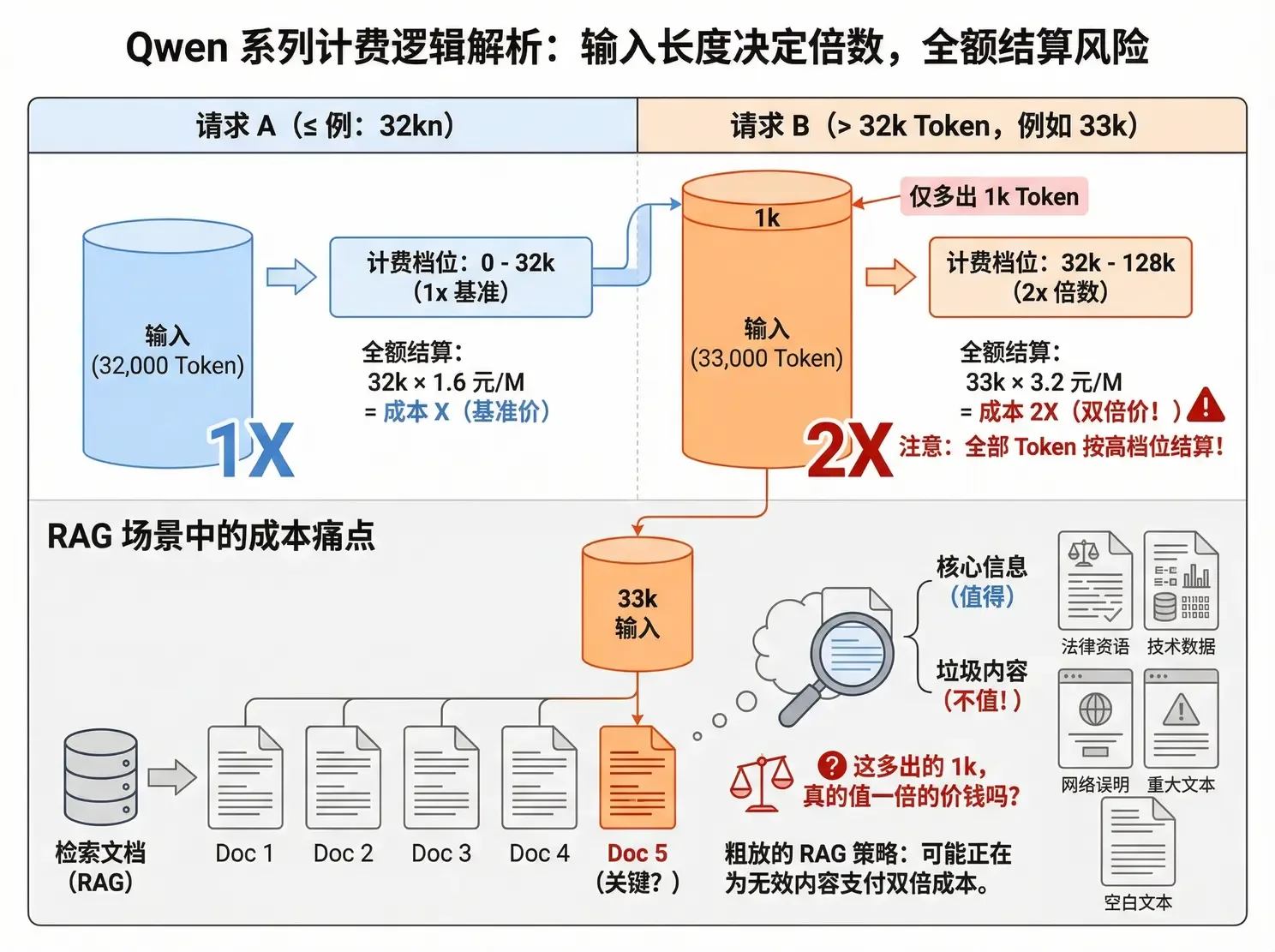
Qwen's tiering logic is the opposite of Zhipu's: bill by input length, with boundaries at 32k and 128k. The detail people miss—crossing the line doesn't surcharge the overflow; it bills the whole request at the higher tier.
| Input length (Qwen3-Max) | Unit price (¥/M, discounted) | vs baseline |
|---|---|---|
| 0 – 32k | 1.6 | 1x |
| 32k – 128k | 3.2 | 2x |
| 128k – 252k | 4.8 | 3x |
Say your input is 33,000 Tokens—only 1,000 over 32k. All 33k Tokens on the request bill at 3.2 ¥/M—not the first 32k at 1.6 and the last 1k at 3.2. That extra 1k doubles the whole request.
Drag input length and watch what happens near the 32k and 128k red lines.
This gets especially sharp in RAG. Suppose retrieval returns 5 chunks that stitch to exactly 33k. Ask yourself: how much does the 5th chunk actually help the final answer?
If it's a core legal clause or a critical tech parameter, maybe it's worth it. But if it's a page footer, copyright notice, a duplicated paragraph, or even leftover newlines from formatting? Sloppy RAG strategies are paying double for junk.
The fix: turn “32k” from a bill shock you discover after the fact into a budget constraint written into code. Prompt assembly can't be mindless concat:
✗ Wrong: mindless concat| Scenario | Strategy | Notes |
|---|---|---|
| RAG retrieval | Dynamic Top-K | Don't always take 5 chunks—take until you're “about to hit 32k” |
| Multi-turn chat | History compression | Trigger Summarization when history nears 30k |
| Long-doc processing | Segmented processing | Don't stuff it all at once—use Map-Reduce |
| Vendor | Tier-jump type | Key threshold | Counter-strategy |
|---|---|---|---|
| Zhipu GLM-4.6 | Output-length tier jump | 200 Tokens | Task splitting, or switch to a non-output-tiered model |
| Qwen | Input-length tier jump | 32k / 128k | Budget-aware truncation; dynamically trim context |
| DeepSeek | Chain-of-thought buildup | Multi-turn inflation | Context scrubbing; discard when done |
Qwen bills the whole request at the higher tier: a 33k request prices all 33k at 2×. 1k more, bill doubles.
Ask “is the 5th chunk worth it?”: sloppy RAG pays double for footers, disclaimers, and newlines.
Encode 32k as a budget constraint in code: sort by relevance, stop at budget. Dynamic Top-K beats fixed Top-K.
Source: Adapted from the author's internal team share “AI Token Cost Engineering Strategies,” section “Qwen's Tier Escape.” RAG cost and optimization also appear from another angle in LLM Fundamentals · RAG Costs & Optimization Strategies—worth reading side by side.