Input-Dominated: a 62:1 I/O Ratio
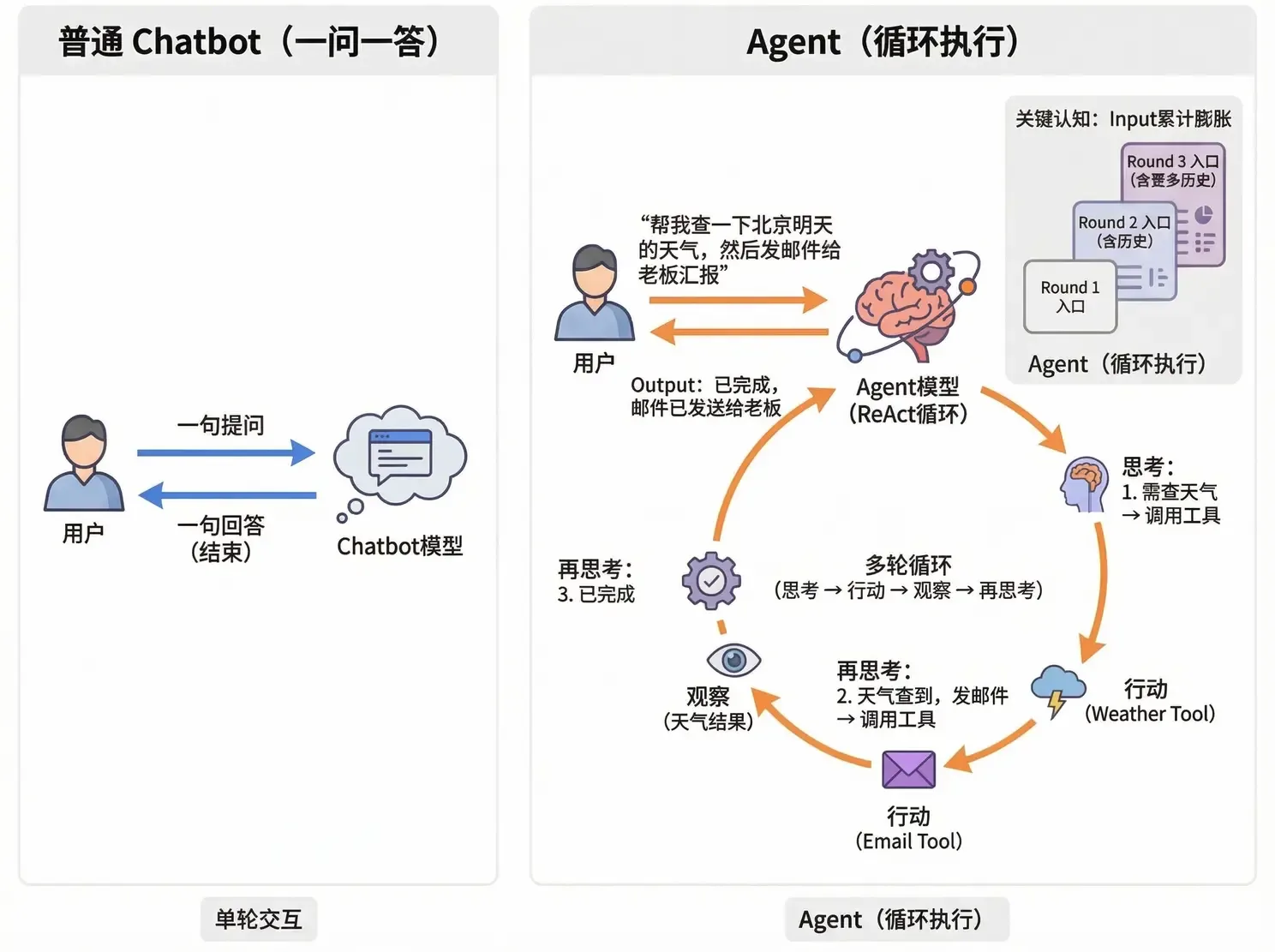
A plain chatbot is one question, one answer; an Agent is a “think → act → observe → think again” loop. The key idea: every turn's Input includes the full history—more turns means longer Input and ballooning cost.
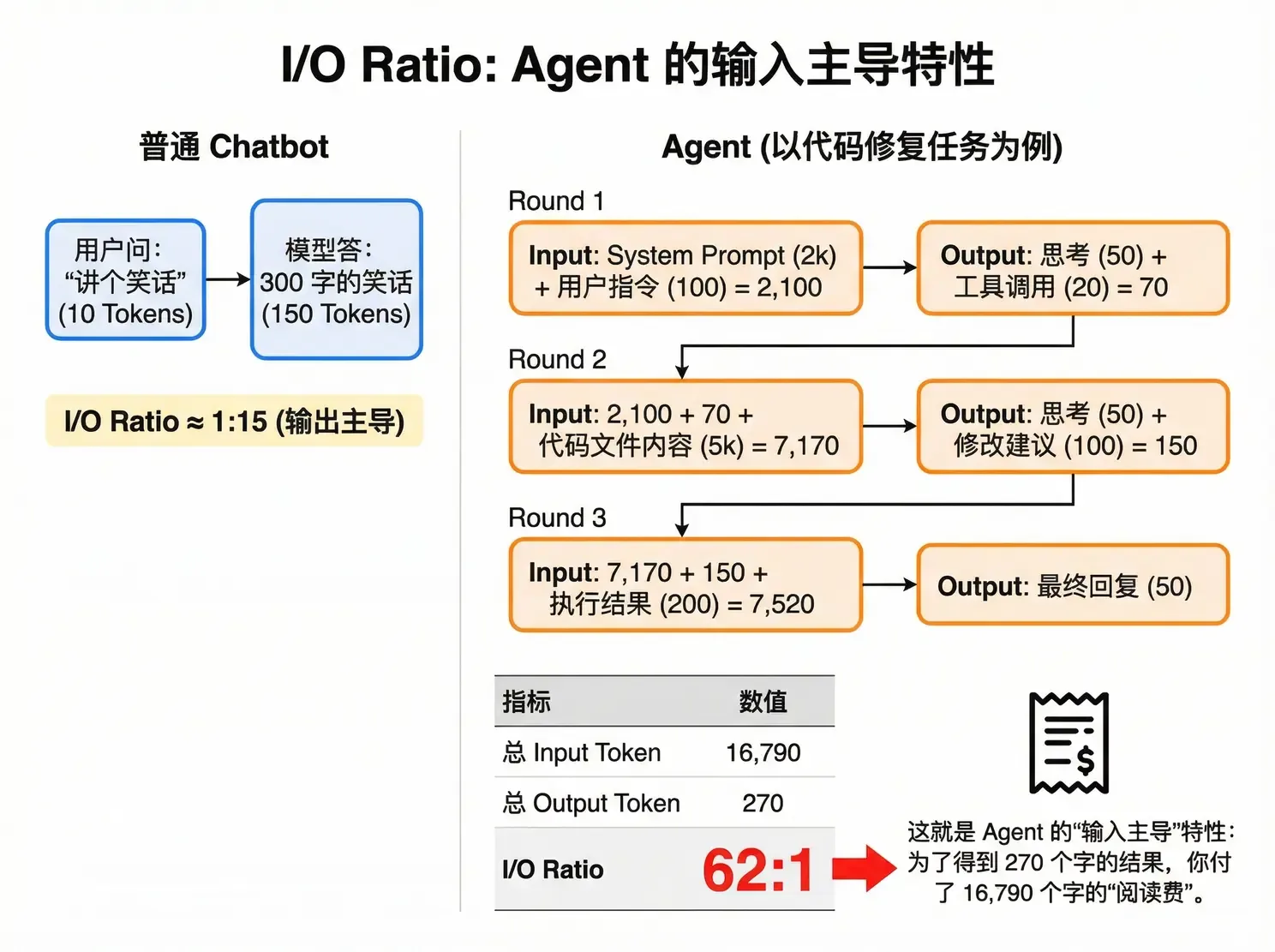
A plain chatbot asks “tell me a joke” (10 Tokens) and answers with 150 Tokens—I/O Ratio ≈ 1:15, output-dominated. An Agent doing a code-fix task: System Prompt, tool returns, and past outputs all get re-read every turn. After three turns, total Input 16,790 and total Output 270—I/O Ratio 62:1, input-dominated.
Task: “Analyze this Excel sheet, find the top-selling product, then generate a chart.” Hit “Next turn” and watch cumulative Input snowball each round.
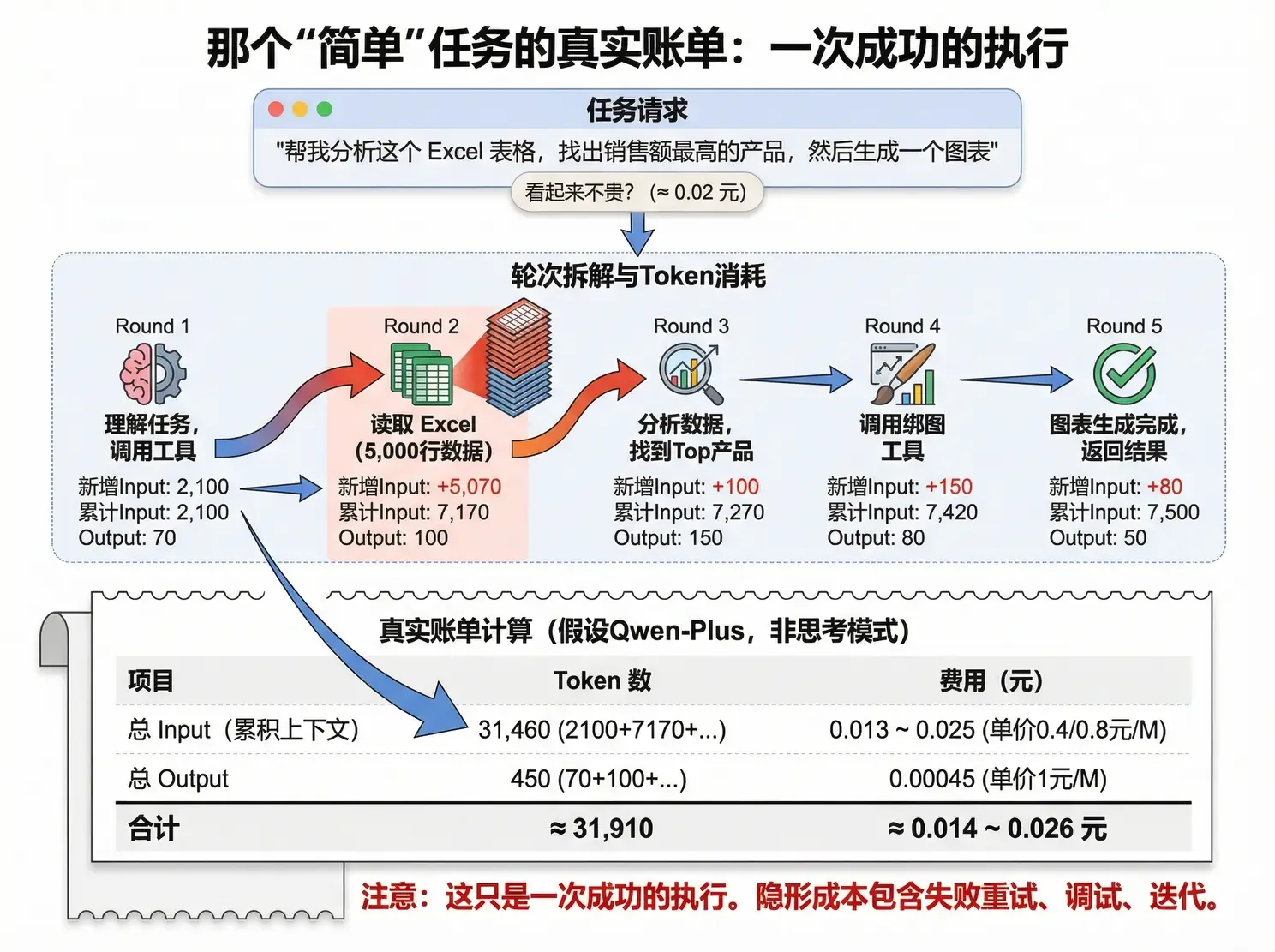
Suppose a task takes N turns, System Prompt length S, and each turn adds about Δ (output + tool return). Turn N's Input ≈ S + Q + Δ×(N-1), and total Input is the sum across all turns—hiding the arithmetic series 1+2+3+…+(N-1). At +500 Tokens per turn, five loops already push total Input past 15,000; double the turns and cost nearly quadruples.
| Agent framework (SWE-bench measured) | Avg. I/O Ratio | Notes |
|---|---|---|
| Simple RAG Agent | 10:1 ~ 20:1 | Retrieve + answer |
| OpenHands | 20:1 ~ 50:1 | Code-fix tasks |
| AutoGPT-class | 30:1 ~ 100:1 | Open-ended tasks, many loops |
That's why KV Cache (lesson 11) is decisive for Agents: if every turn re-reads the same prefix, a cache hit is a 5× price gap. It also explains why you should watch I/O Ratio—above 50:1 usually means the Agent is spinning / idle looping, so optimize the workflow or degrade the task.
Agents are input-dominated: every turn's Input carries the full history; total volume grows roughly with the square of turn count.
One run looks cheap; scale is where it bites: a ¥0.02 task × failed retries × a million calls is the bill-shock moment.
Treat I/O Ratio as a health metric: >50:1 means the Agent is spinning—fix the workflow before you chase savings.
Source: Adapted from the author's internal team share “AI Token Cost Engineering Strategies,” section “Billing Mechanics for Agentic Apps.” Industry data references SWE-bench studies of Agent Token consumption (see Finale reading list). For Agent loop fundamentals see Hands-On Practice.