Four Agent Cost Traps and the Circuit Breaker
Last lesson was still “one successful run.” In the real world, Agent bill accidents come from four directions: tool-return explosion, thinking tax, infinite loops, and history snowball. Each has an engineering fix.
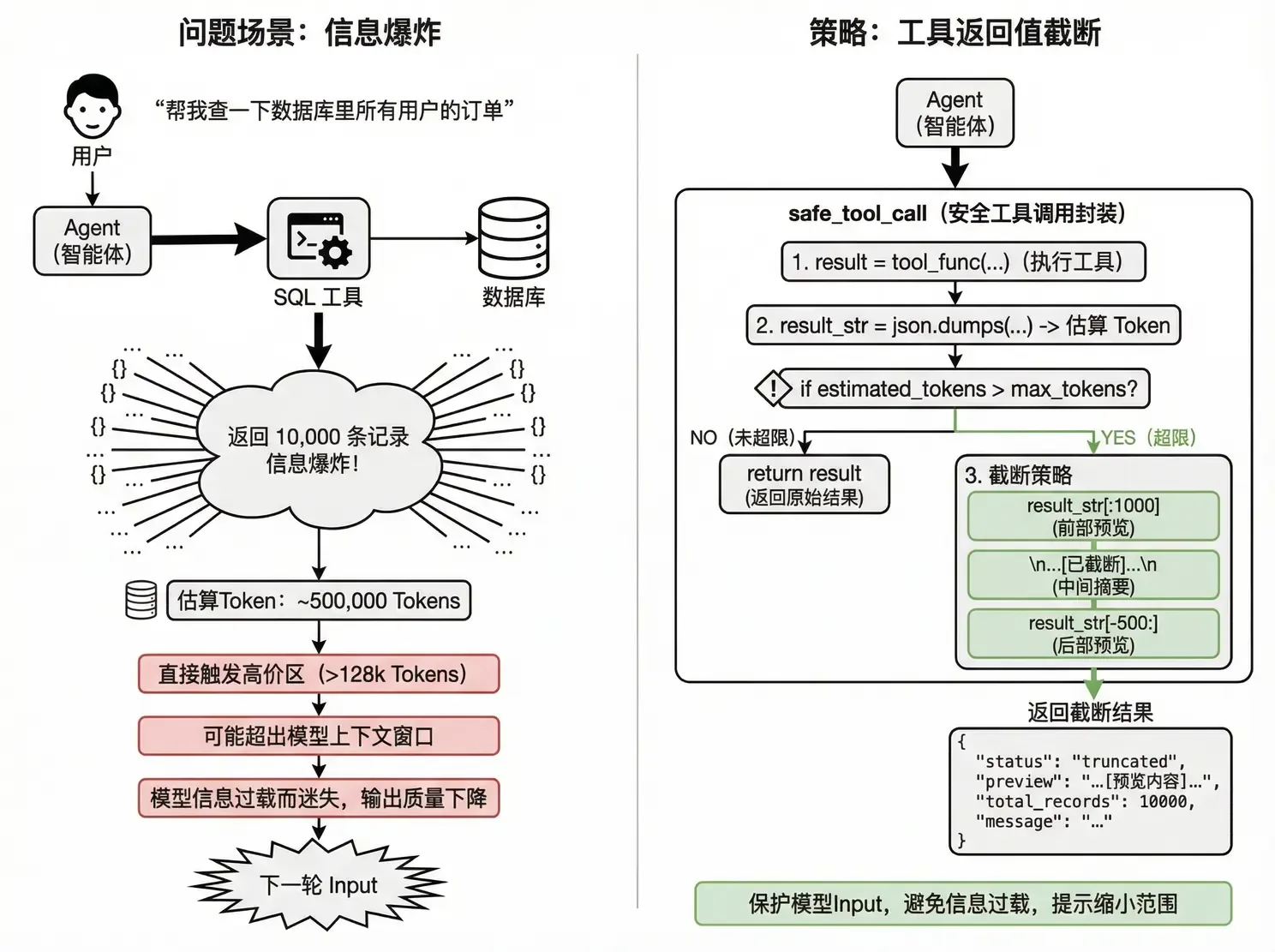
User says “pull every user's orders from the database,” the Agent's SQL tool returns 10,000 rows ≈ 500,000 Tokens. Those 500k Tokens get stuffed into the next turn's Input: you trip the expensive tier, maybe blow the context window, and the model “gets lost” under overload so output quality drops. The fix is a truncation guard on every tool:
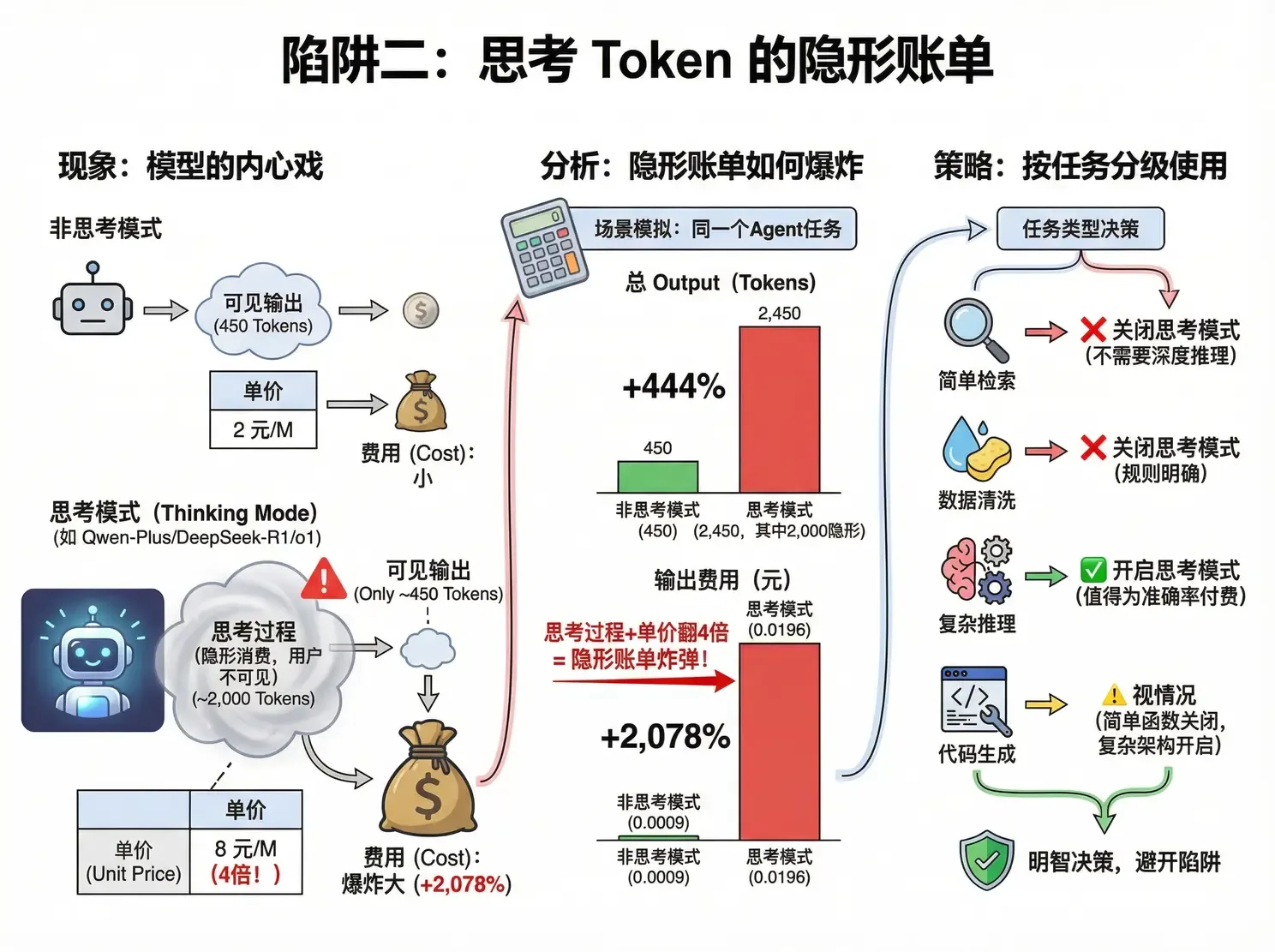
Qwen-Plus thinking mode, DeepSeek-R1, o1 and similar models emit a “thinking process”: users may never see it, but it's all billed as Output—and the unit price is 4× (Qwen-Plus non-thinking output 2 ¥/M, thinking mode 8 ¥/M). Same Agent task with thinking on: visible output unchanged (450 Tokens), thinking process +2,000 Tokens, output spend jumps +2,078%.
| Task type | Thinking mode | Why |
|---|---|---|
| Simple retrieval | ❌ Off | No deep reasoning needed |
| Data cleaning | ❌ Off | Rules are clear—no “thinking” required |
| Complex reasoning | ✅ On | Worth paying for accuracy |
| Code generation | ⚠️ It depends | Off for simple functions; on for complex architecture |
Advanced fix: use a ~0.6B tiny model as a front-door triage—spend a few 厘 first to decide whether this request needs deep thinking, then route to the right mode. That's the concrete shape of lesson 3's “T2 backs up T0.”
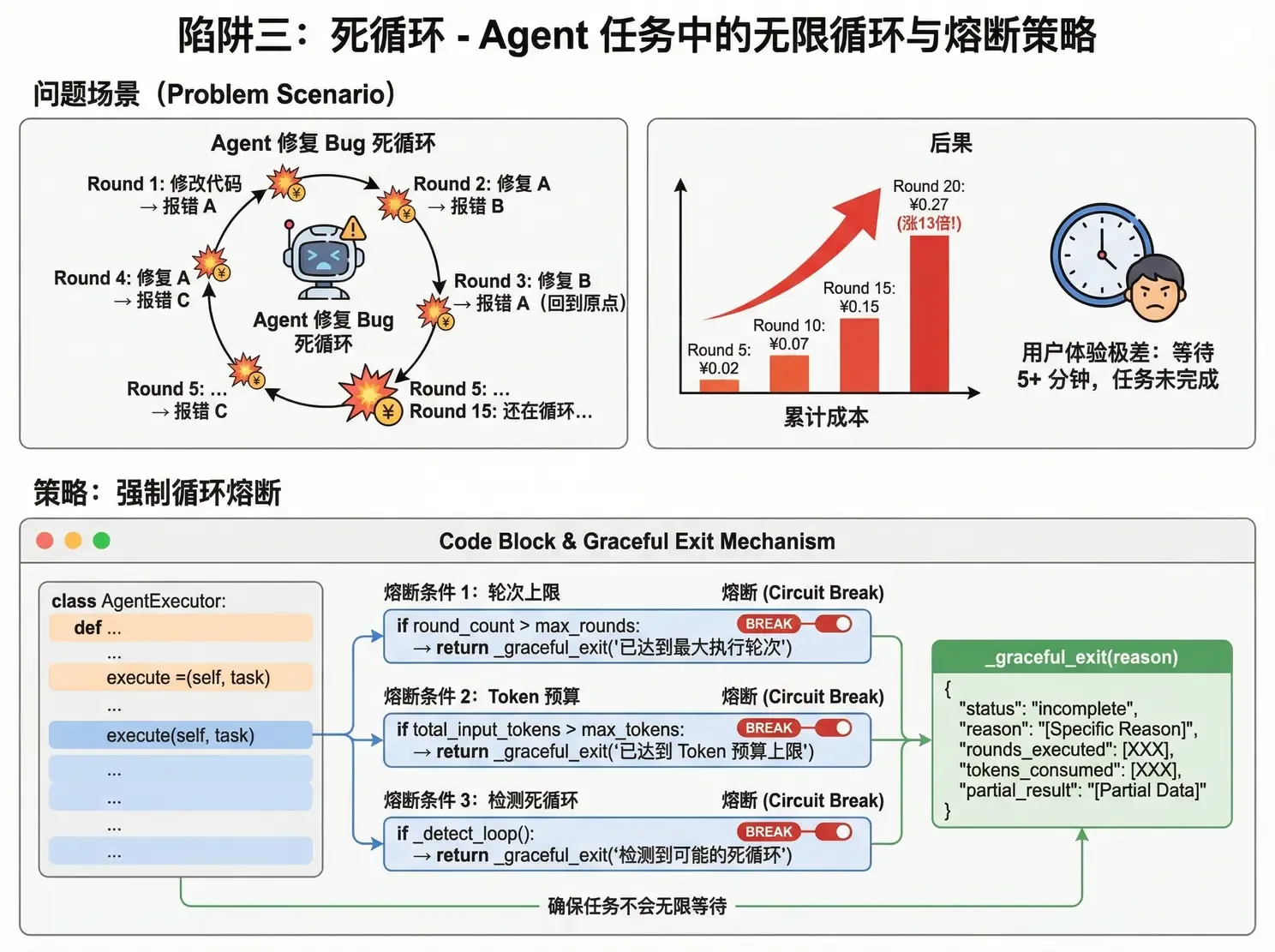
Agent fixing a bug: fix A → error B → fix B → error A (back to square one) → … still spinning at turn 15. If Input grows 1,000 Tokens per turn, 20 turns cost 13×; worse, the user waited 5 minutes with nothing done. The fix is a forced circuit breaker—graceful exit when any of three conditions hits:
On graceful exit, return rounds_executed, tokens_consumed, and partial_result—a half-finished artifact beats a black hole.
The standard (wrong) approach stuffs the full history into Input every turn. The better approach is fixed prefix + compressed history + last N turns: never compress the System Prompt (preserve the cache prefix), keep the last 3 turns verbatim, and squash older history into one summary sentence with a small model.
| Approach | Turn-10 Input | Notes |
|---|---|---|
| Unbounded growth | ~50,000 Tokens | Includes full history |
| Sliding window (last 5 turns) | ~12,000 Tokens | Loses early context |
| Fixed + summary + last 3 turns | ~6,000 Tokens | Keeps what matters, controls length |
| Control point | Strategy | Expected gain |
|---|---|---|
| Tool returns | Truncate + summarize, cap 2k Tokens | Stop single-turn explosions |
| History management | Fixed prefix + compress old history | Cut Input 50%+ |
| Loop control | Circuit-breaker mechanism (turns / Tokens / loop detect) | Stop bottomless pits |
| Thinking mode | Enable by task tier | Cut Output cost ~4× |
| Model selection | Small models for simple subtasks | Lower unit price |
| Cache use | Fixed System Prompt, hit KV Cache | Cut Input cost ~90% |
| Red line | Suggested threshold | Consequence | Response |
|---|---|---|---|
| Per-turn Input | < 32k Tokens | Jump into expensive tier | History compression + tool truncation |
| Total turns | < 10 turns | Cost grows exponentially | Circuit-breaker mechanism |
| I/O Ratio | Watch > 50:1 | Agent is “spinning” | Optimize workflow or degrade the task |
Cap tool returns at 2k: truncate + summarize + tell the model to narrow scope—stop single-turn Input explosions.
Tier thinking mode by task: the invisible inner monologue still bills as Output, at 4× the unit price.
Circuit breakers are the Agent's fuse: hit any of turns, Token budget, or loop detection → graceful exit.
Manage history with “fixed + summary + last 3 turns,” half the cost of a blunt sliding window without amnesia.
Source: Adapted from the author's internal team share “AI Token Cost Engineering Strategies,” section “Billing Mechanics for Agentic Apps.” Product angles on Agent freezes and fool-proofing are covered in Hands-On Practice; for context compression also see Harness Core · Context Overflow.